
Concrete coatings for the Fox Cities
Epoxy Flooring in Appleton, WI
Garage, basement and shop floors prepared for road brine, deep cold and clay-soil moisture, with a written price before work starts.
- Free on-site estimate with a slab moisture check
- Itemized written quote: prep, coats, square footage, total
- Every floor diamond ground and patched before coating
What an Appleton Floor Has to Survive
Epoxy flooring in Appleton gets tested every winter. Wikipedia's climate table for the city lists about 49 inches of snow a year, a January average high of 25.4°F and an average January low of 10°F. From late fall into spring, cars come home wet with slush and road brine, park on a slab that may be well below freezing, and drip. A garage coating here needs a strong mechanical bond to the concrete, a topcoat that shrugs off salt, and some texture so a wet floor is not slick.
Road brine and the strip inside the garage door
The City of Appleton pre-wets its road salt and keeps brine tanks for winter work, according to a 2022 All Things Appleton report on the city's Municipal Services Committee. Pre-wetting helps the salt work with less product, and the city's salt use has trended down since 2000. It is still salt, and it still ends up on your garage floor. A 2008 literature review written for the South Dakota Department of Transportation by the Michigan Tech Transportation Institute found that sodium chloride usually damages concrete through severe scaling during freeze-thaw cycles, and that magnesium chloride is considered more damaging than sodium chloride. On a bare slab, that shows up as flaking and pitting in the first few feet inside the door and in the tire tracks. A sealed coating keeps the brine on the surface, where a squeegee can push it out.
The age of Appleton's slabs
Appleton is not a new-build city. American Community Survey figures for 2019 to 2023, summarized by Point2Homes, put the median year built for local housing at 1971. About 19% of units date to 1939 or earlier, and the 1970s alone account for almost 17%. Roughly two-thirds of occupied homes are owner-occupied, which is why we see so many garages that have had decades of DIY paint, store-kit epoxy or sealer applied over them. Those layers have to come off. A slab from the 1950s may also have wide cracks, a sunken section near the apron, or a patch from an old repair that bonds differently from the original concrete.
Clay ground and damp basements
The soils around the Fox Cities formed in old glacial lake basins. The Winneconne soil series, first established in Outagamie County in 1975, is described by the USDA as clayey lake sediment with very slow permeability and a perched seasonal water table 1.5 to 3.5 feet down. Water that sits in clay next to a foundation can work its way up through a basement slab as vapor. That vapor is the most common reason a basement coating blisters or lets go. We check basement floors for moisture before we recommend anything, and we tell you if the slab needs a moisture-tolerant primer or a water fix first.
Floor systems we install
- Garage floor epoxy with a protective topcoat: a thick epoxy base that grips ground concrete, sealed with a UV-stable, chemical-resistant clear coat.
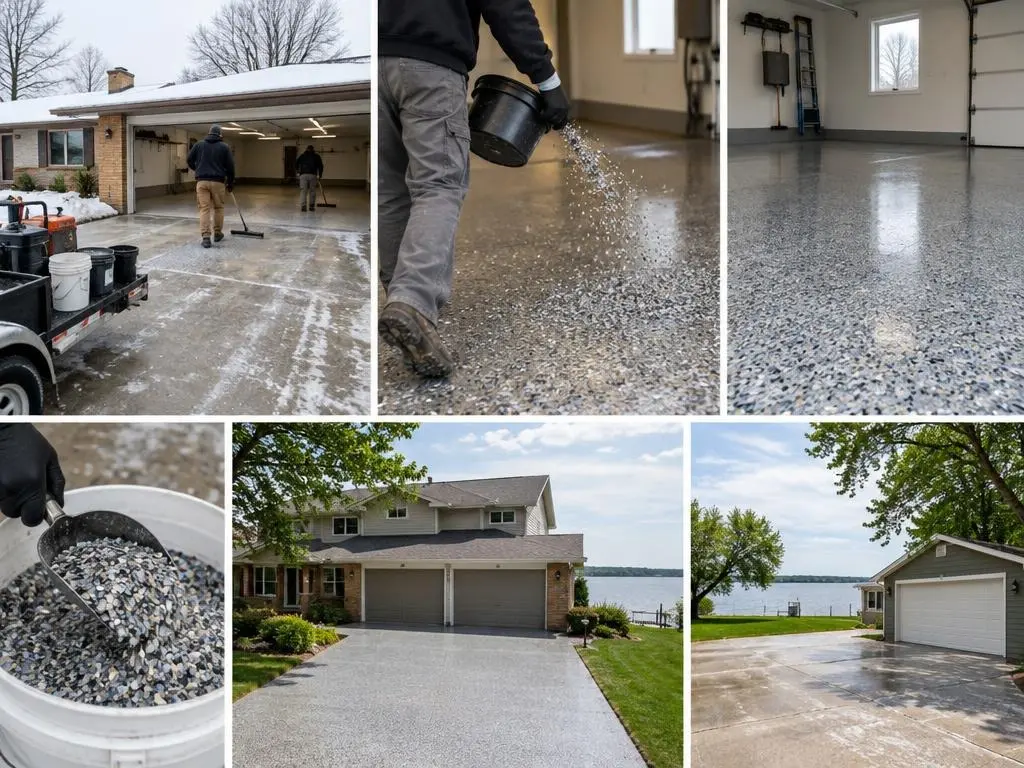
- Flake epoxy floors: colored vinyl chips broadcast into the wet base for texture and a finish that hides grit and salt film.
- Polyaspartic coatings: a fast-curing system that suits Wisconsin's short install windows and gets cars back in the garage sooner.
- Basement floor coatings: systems chosen after a moisture test, from simple solid colors to flake.
- Metallic epoxy floors: poured, swirled finishes for finished basements, bars and shop showpieces.
- Shop and warehouse floors: thicker 100% solids systems for forklifts, rolling carts, welding spatter and fluids.
Wisconsin seasons and scheduling
Resin coatings have temperature limits. Each product lists a minimum slab and air temperature, and an unheated Appleton garage in January can sit below that for weeks. In cold months we check the slab temperature, may heat the space ahead of time, and often lean toward polyaspartic, which HomeGuide lists as having a much wider application temperature range than epoxy. Summer has its own issue: Appleton's record dew point of 90°F, set in July 1995, is an extreme case, but humid days can make a cool slab sweat. We plan around both.
How a typical job runs
- You clear the garage or room, or we talk through what can stay in a corner.
- We grind the whole floor with diamond tooling and vacuum the dust as we go.
- Cracks, pits and spalled spots are filled, and control joints are filled or kept, your choice.
- Base coat, color or flake, and a clear topcoat go down, usually over one or two days.
- You get written times for foot traffic, moving shelves back and parking.
What it costs
HomeGuide puts professionally installed epoxy at $4 to $10 per square foot, or about $1,600 to $5,800 for a two-car garage of 400 to 576 square feet. At that rate a 1,500 square foot floor would run about $6,000 to $15,000, and 2,000 square feet about $8,000 to $20,000. Polyaspartic runs $5 to $12 per square foot in the same source. Removing an old coating, repairing scaled concrete and dealing with moisture move the number, which is why we price after seeing the floor. Your written estimate is the price.
Floor Coating Services in Appleton
Six coating services for the floors we see most around the Fox Cities: salt-worn garages, clay-country basements and hard-used shops.
Garage Floor Epoxy
A ground, patched and sealed garage slab with a topcoat that handles road brine and hot tires.
Learn more →Flake Epoxy Floors
Broadcast chip floors that add grip, hide grit and salt film, and come in dozens of color blends.
Learn more →Polyaspartic Floor Coatings
A fast-curing coating system for short Wisconsin install windows, with cars back in the garage in about a day.
Learn more →Basement Floor Coatings
Moisture-tested basement coatings for laundry rooms, rec rooms, gyms and storage on Fox Cities clay ground.
Learn more →Metallic Epoxy Floors
Poured, swirled metallic finishes for finished basements, bars, studios and showpiece garages.
Learn more →Shop & Warehouse Floor Epoxy
Heavy-duty coatings for workshops, pole buildings, warehouses and commercial back rooms.
Learn more →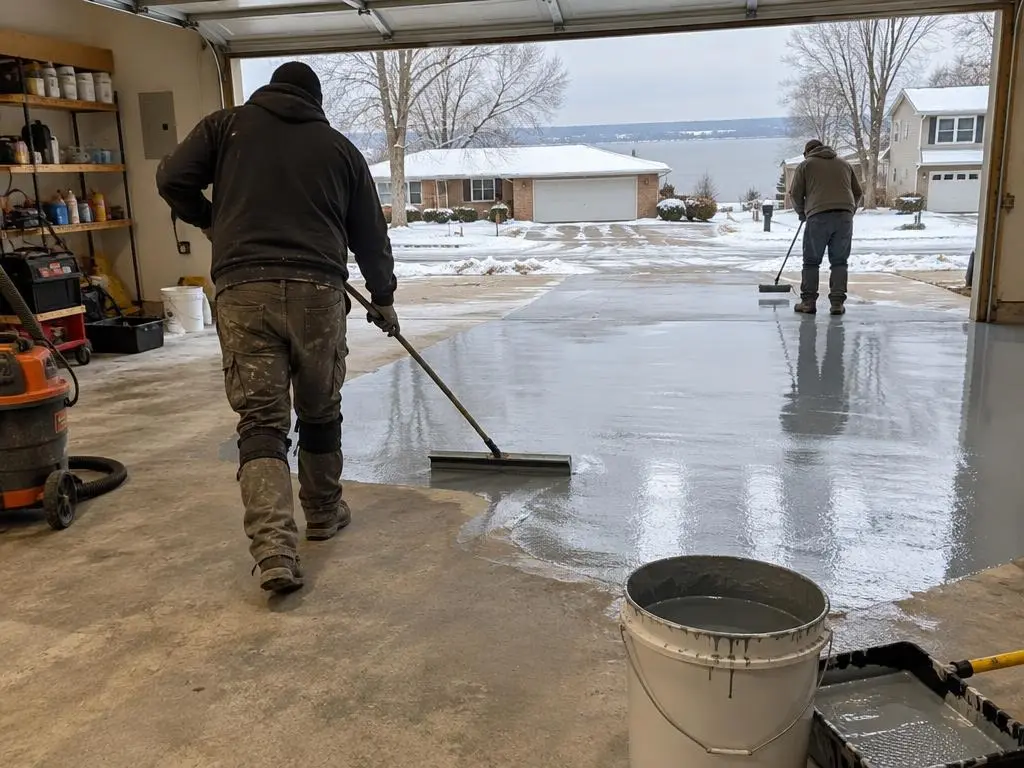
Where We Work
Appleton is home base. We also coat floors throughout the Fox Cities and around Lake Winnebago: Grand Chute, Neenah, Menasha, Fox Crossing, Kaukauna, Little Chute, Kimberly, Combined Locks, Harrison, Sherwood, Greenville, Hortonville, Freedom, Buchanan and Clayton, plus Oshkosh, Winneconne, De Pere, Wrightstown, New London, Black Creek and Chilton. The floors differ from town to town. Kaukauna, Kimberly, Little Chute and Combined Locks grew up along the Fox River around mills and locks, and their older neighborhoods have older slabs. Harrison and Greenville have grown quickly over the last two decades, so more of their garages are newer. Communities around Lake Winnebago and the lower Fox sit on the same slow-draining lake clay as Appleton, which shapes basement work. Each town page covers what we know about floors there.
- Epoxy Flooring in Appleton, WI
- Epoxy Flooring in Grand Chute, WI
- Epoxy Flooring in Neenah, WI
- Epoxy Flooring in Menasha, WI
- Epoxy Flooring in Fox Crossing, WI
- Epoxy Flooring in Kaukauna, WI
- Epoxy Flooring in Little Chute, WI
- Epoxy Flooring in Kimberly, WI
- Epoxy Flooring in Combined Locks, WI
- Epoxy Flooring in Harrison, WI
- Epoxy Flooring in Sherwood, WI
- Epoxy Flooring in Greenville, WI
- Epoxy Flooring in Hortonville, WI
- Epoxy Flooring in Freedom, WI
- Epoxy Flooring in Buchanan, WI
- Epoxy Flooring in Clayton, WI
- Epoxy Flooring in Oshkosh, WI
- Epoxy Flooring in Winneconne, WI
- Epoxy Flooring in De Pere, WI
- Epoxy Flooring in Wrightstown, WI
- Epoxy Flooring in New London, WI
- Epoxy Flooring in Black Creek, WI
- Epoxy Flooring in Chilton, WI
Why Homeowners Call Epoxy Flooring Appleton
Grinding before every coating
We diamond grind the full slab, edges included, so the base coat bonds to clean, open concrete. Acid etching alone does not remove old sealer or salt-weakened surface.
A moisture check on clay ground
Fox Cities soils hold water. We test basement and suspect slabs before choosing a primer or system.
Built for brine and cold
Garage floors get a chemical-resistant topcoat and slip texture so wet winter floors stay cleanable and safer to walk on.
A price you can read
Your quote spells out the square footage, prep steps, each coat and the total. Changes are written up for your approval first.
Common Questions
How much does a 1,500 square foot epoxy floor cost?
Using HomeGuide's national installed range of $4 to $10 per square foot, 1,500 square feet works out to about $6,000 to $15,000. A polyaspartic system at $5 to $12 per square foot would be about $7,500 to $18,000. Old coatings, crack repair and moisture work add to that, so we give a written price after seeing the floor.
How much does it cost to epoxy 2,000 square feet?
At HomeGuide's $4 to $10 per square foot, 2,000 square feet comes to roughly $8,000 to $20,000. Floors that size are usually basements, shops or commercial spaces, and they vary a lot with slab condition and how heavy the use is. A commercial 100% solids system can run $12 or more per square foot according to HomeAdvisor.
What is the downside of epoxy flooring?
Epoxy needs a dry, well-prepared slab, and it peels when moisture or oil is trapped underneath. Standard epoxy can take up to a week to fully cure, can yellow in sunlight without a UV-stable topcoat, and is slippery when wet unless flake or grit is added. Each of these is handled by prep and system choice, which is why we look at the slab first.
Is epoxy worth it in a Wisconsin garage?
For a garage that takes road brine every winter, a well-bonded coating keeps salt out of the concrete and makes cleanup a squeegee job. It is not worth doing over a slab with active water coming through or a heaved section. We will tell you if that is your situation.
Can you coat a garage floor in an Appleton winter?
Sometimes. Every resin has a minimum slab and air temperature, and an unheated garage in January is often below it. We check the slab, may heat the space, and often choose a polyaspartic system for cold-season work. If conditions are not right, we schedule for a warmer stretch.
Why did my store-bought epoxy kit peel?
Usually the bond failed. Most kits rely on acid etching, which does not remove old sealers or weak, salt-damaged concrete, and thin water-based coatings may need recoating every 3 to 5 years according to HomeGuide. Hot tires then lift the film. Diamond grinding and a thicker system fix the underlying problem.
Does a basement coating stop radon?
No. Wisconsin's Department of Health Services says about 1 in 10 homes in the state has high radon, which usually enters through the foundation. Sealing cracks and coating the slab is not a mitigation system. Test first with a $10 to $30 kit; if you need mitigation, it is easier to install before the floor is finished.
Get a Free Floor Coating Estimate
On-site estimates in Appleton and across the Fox Cities. Call [PHONE] or send the form.